Face — Treatment
The ear,
that disappears.
The ear, done well, is the feature you do not notice. Otoplasty reshapes prominent, asymmetric or absent ear cartilage so that the ear stops drawing attention — and the rest of the face does its work. About one in ten people have some form of structural ear difference.
What it is & what it isn't
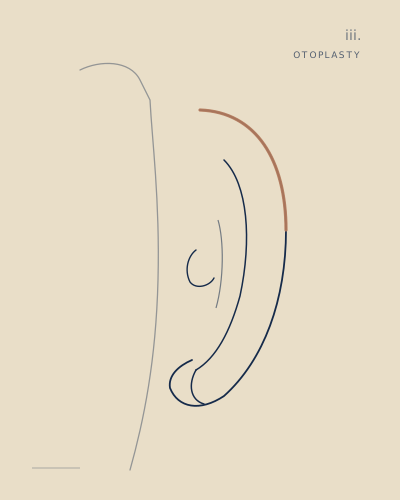
Otoplasty corrects the position, shape or size of the ear by reshaping the underlying cartilage. The most common procedure is ear pinning — bringing prominent ears closer to the head through a small incision behind the ear. Other variants reduce large ears, rebuild congenital or traumatic defects, or correct asymmetry.
What it isn't
Not a procedure that should be rushed in children. The ears reach near-adult size around age five — surgery before that risks growth disruption. After five, otoplasty is well-tolerated; before five, we wait. For adults, this is a one-day, low-disruption operation. We do not perform earlobe-stretching reversals at this clinic; that is a different surgery family.
The practical detail
What you are actually committing to.
- Procedure time
- Typically 1–2 hours
- Anaesthesia
- General (children) or local (adults)
- Stay in Antalya
- Typically 1–2 days
- Flying home
- Next day to 3 days
- Light exercise
- Typically 1–2 weeks
- Full exercise
- Typically 4–6 weeks
- Final result
- Typically 2–3 months
- Scarring
- Behind the ear, hidden in the natural fold
- Permanence
- Permanent
These figures are typical ranges, for planning your trip. Your own treatment and recovery timeline is assessed and decided by Dr. Meral — at consultation, and again as your healing progresses.
How it unfolds
The consultation
What specifically about the ear — prominence, size, fold absence, asymmetry, lobe shape. For children, a calm conversation that includes the child. For adults, an honest one about whether the issue is best solved surgically or simply lived with.
The plan
Markings made with the head facing forward. The behind-ear incision line is planned; the cartilage maneuvers are chosen — scoring to weaken cartilage that resists folding, sutures to set the new fold, excision where excess cartilage is present.
The surgery
Incision behind the ear. The skin is lifted off the cartilage. The cartilage is reshaped — scored, sutured, sometimes resected — until it sits where it should. The skin is replaced and closed.
The first night
A bulky head-wrap dressing. Mild discomfort. Children typically sleep through; adults are usually surprised at how little it hurts.
Recovery
Head-wrap dressing for 5–7 days. A soft elastic headband worn at night for several weeks to protect the new ear position. Sutures (where non-dissolving) removed at day 7. Back to school or work in 7–10 days. The ears feel tight for a few weeks; this is the cartilage settling. Full result at two to three months.
A typical course, not a promise — healing differs from person to person. Dr. Meral reviews you at each follow-up and decides when each step is right for you.
This may be for you if
- Your ears protrude in a way that bothers you (or your child), beyond casual self-consciousness
- You're past age five — the ears have reached near-adult size
- You can tolerate a head dressing for a week and a night headband for several weeks more
- You want the ears to stop being a feature, not become a different one
This is not for you if
- Your child is under five — we will not rush the surgery; the ears are still growing
- You're chasing a particular ear shape from a photograph rather than your own anatomy
- You expect perfect symmetry — ears are naturally asymmetric, and surgery improves but does not erase that
- You're considering this purely to satisfy someone else — this is a surgery that needs to come from you
Begin
A conversation,
not a quote.
- +90 532 508 39 50
- info@mertmeral.com
- Hours
- Monday — Saturday · 09:00 — 19:00 (UTC+3)
The map is served by Google Maps — loading it shares your IP address with Google.